When Work Place Cultures Collide: A Case for Cultural Intelligence
By: Vivian Acquah CDE®

A recent post on Reddit caught my attention. It perfectly illustrates why technical skills alone are not enough for effective leadership. The story involves an employee working in the Netherlands for the Dutch branch of a large US tech company. Everything was fine until a new middle manager arrived, based in New York.
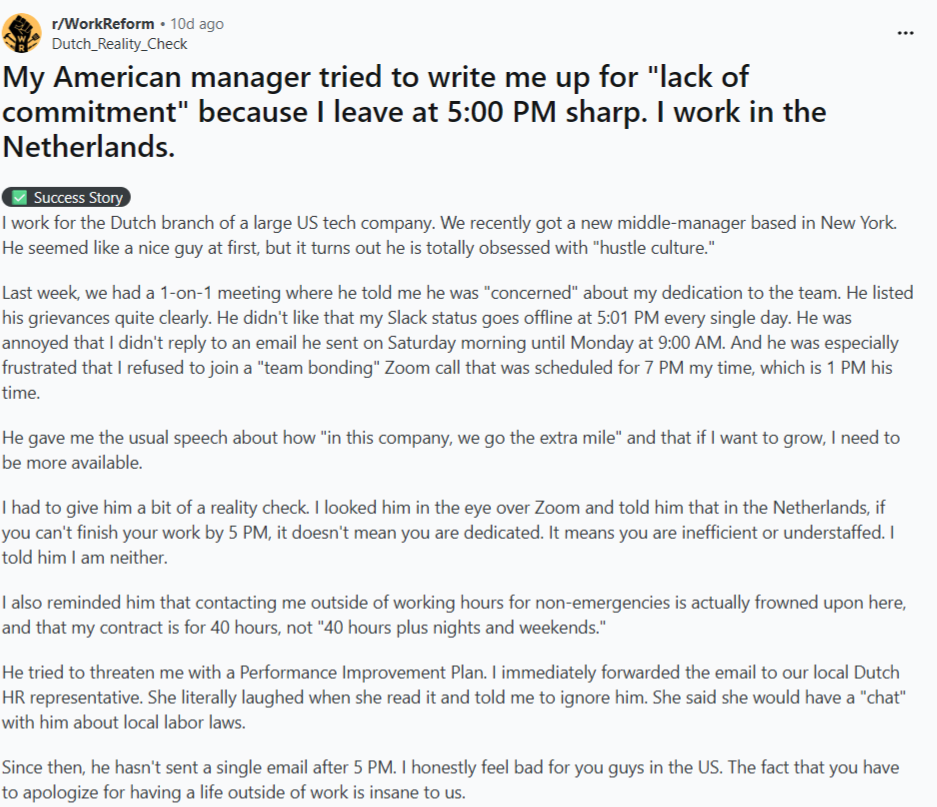
The employee wrote: “My American manager tried to write me up for lack of commitment because I leave at 5:00 PM.”
The manager, described as “totally obsessed with hustle culture,” viewed the standard Dutch working hours as a lack of dedication. This friction point is not just about timekeeping. It is a classic example of ineffective collaboration driven by a lack of Cultural Intelligence (CQ).
When we ignore the undercurrents in our teams, we “invite” conflict. We misinterpret behaviour. We damage trust. Furthermore, we boost psychological unsafety. As leaders and team members, we need to look deeper than the surface level of “who works the longest hours.”
We all carry a blueprint of what “good work” looks like. For the American manager in this story, “good work” likely involves visibility, long hours, and constant availability. This is often rewarded in US corporate culture. It signals ambition.
In the Netherlands, the blueprint is different. Efficiency is highly valued. If you can finish your work by 5:00 PM, you are effective. Staying late might actually signal that you cannot manage your workload properly.
When these two blueprints collide without a mediator, you get ineffective collaboration. The manager sees a slacker. The employee sees a tyrant. Neither perception is true, but both feel real.
This is where unconscious bias thrives. The manager likely holds a bias that “leaving on time equals disinterest.” The employee might hold a bias that “American managers have no work-life balance.” These biases act as filters. They stop us from seeing the person and their actual contribution. Instead, we judge them based on our own programming.
Cultural Intelligence, or CQ, is the capability to function effectively in culturally diverse situations. It is not just about knowing that people eat different foods or celebrate different holidays. It is about understanding how culture shapes our values, our communication, and our work styles.
In the case of the Dutch employee and the American manager, a lack of CQ caused a breakdown. A culturally intelligent leader would pause before writing up the employee. They would ask questions. They would seek to understand the local norms.
If you are a leader managing a cross-cultural team, you must educate yourself. You cannot simply export your home culture’s expectations and assume they will work everywhere. That is a recipe for resistance and high turnover.
You need to advise your stakeholders and your team members to assess their own CQ levels. This is not just a “nice to have” soft skill. It is a strategic necessity. When you understand your own cultural lens, you can adjust it. You can see that a 5:00 PM departure is not a personal insult or a lack of commitment. It is simply a different way of structuring the day.
Beyond national culture, we also deal with individual working styles. This adds another layer of complexity.
Some people are early birds. They focus best at 7:00 AM. Others are night owls who do their best thinking after dinner. Some people prefer deep, uninterrupted focus. Others thrive on collaboration and constant chatter.
When we force everyone into the same box, we kill productivity. We also create friction.
As a CQ® facilitator, I would recommend leaders and their teams conduct assessments to map these preferences. You need to know who is who. If you know that your colleague is a night owl, you will not judge them for starting later in the morning. You will understand that their late-night emails are just their peak productivity time, not a demand for you to reply instantly.
This assessment demystifies behaviour. It removes the moral judgment we often attach to work styles. We stop thinking “she is lazy” or “he is intense” and start thinking “she needs quiet time” or “he prefers rapid communication.”
As a leader, you set the tone. If you praise the person who stays until 9:00 PM but ignore the person who finished efficiently at 5:00 PM, you might invite traits that hinder effective collaboration. You tell your team that you value suffering more than success.
You must help your team collaborate effectively by understanding these undercurrents. Furthermore, you are the bridge. You need to translate the “hustle” of New York to the “efficiency” of the Netherlands, and vice versa.
In the end, the goal is psychological safety. The Dutch employee in the story likely felt unsafe, undervalued, and misunderstood. That is not an environment where innovation happens. That is an environment where people do the bare minimum to survive.
Ineffective collaboration is a choice. You can choose to ignore these differences and let friction burn your team out. Or you can choose to embrace Cultural Intelligence, understand diverse working styles, and build a team that works smarter, not just longer.
The American manager saw a problem. A culturally intelligent leader would have seen an opportunity to learn a different, perhaps healthier, way of working. Which leader will you be?
Written by Vivian Acquah CDE®, certified inclusion strategist, Amplify DEI and CQ® facilitator.
Connect with Vivian on Linkedin