Are Americans or Brits More Risk-Averse?
By: Benjamin Krzywicki
Tagged: Behaviour Preferences and Cultural Values

Imagine you’re walking down the street when you’re approached with an amazing offer. You could either get 50,000 in cash today, guaranteed, or flip a coin for a 50/50 chance at 1,000,000.
That was the question asked to just over 20,000 people in the United Kingdom and United States by YouGov this past July.
The results: 73% of Britons would take the guaranteed £50,000, while just 21% would take the risk for the £ 1,000,000.* Over in the USA, 65% said they would take the guaranteed $50,000, while 25% said they wanted the risk of winning it all.
Many media outlets in both countries reported only their country’s results. With only half the results shown, people felt their country was overly risk-averse compared to their counterparts. This is despite both countries being well in the majority for taking the guaranteed winnings.
The results and reaction are a great example of the behavioral preference, uncertainty avoidance.
High versus Low uncertainty avoidance is one of the 10 key behavioral preferences. Uncertainty Avoidance is the extent to which you prefer to be flexible and adapt to changing circumstances versus reducing and avoiding uncertainty.
Low Uncertainty Avoidance: Emphasizes flexibility, adaptability, and risk-taking. It may be perceived as being unprepared, disorganized, and risky.
High Uncertainty Avoidance: Emphasizes planning, predictability, and thoroughness. It may be perceived as uptight, inflexible, and overly cautious.
When you look at data from most sources on cultural clusters, we see that Anglo countries like the United Kingdom and the United States tend to fall on the Low Uncertainty Avoidance side.
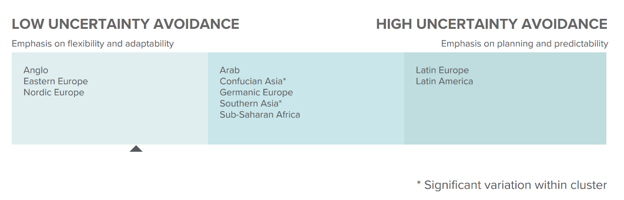
That doesn’t match what we saw in the survey. In both countries, a majority were on the side of the certain outcome. But nationality is only one layer of culture.
When we talk about Culture, it’s never just about your nationality. Culture is a shared pattern of beliefs, values, assumptions, and behaviors that distinguishes one group from another. When we talk about culture, we could be looking at company, generational, geographical, national, regional, or so many other shared groups.
The YouGov poll found differences among these other groups. The most drastic difference was in gender. In the USA, men were more willing to take the risk, at 32% vs. only 18% for women. The difference was more drastic in the UK, with 30% of men willing to take the gamble versus just 13% of women. In both countries, younger generations were also, on average, more willing to take the chance at a million than older generations.
The USA saw a regional shift, with the western part of the country more likely to take a chance on the million-dollar prize than any other region. As well as a large divide in the poll when broken down by race.
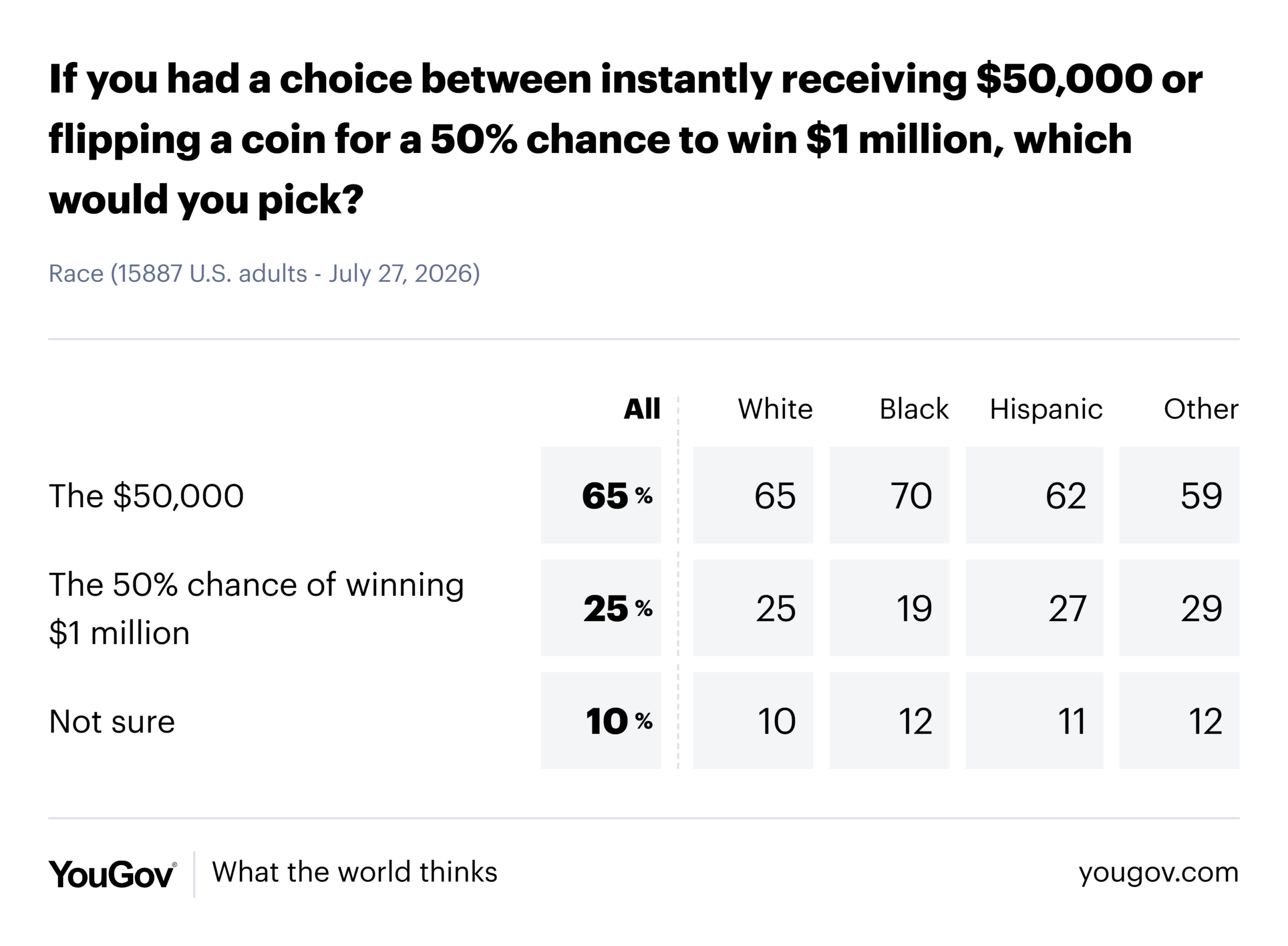
These surveys highlight that cultural influences extend far beyond national borders. Cultural intelligence allows you to better understand and respond to these cultural differences.
So, if you were offered the choice, would you take the 50,000 or the chance at 1,000,000?
* In both groups, some participants didn’t know what choice to make: 6% for Britons and 10% for Americans.